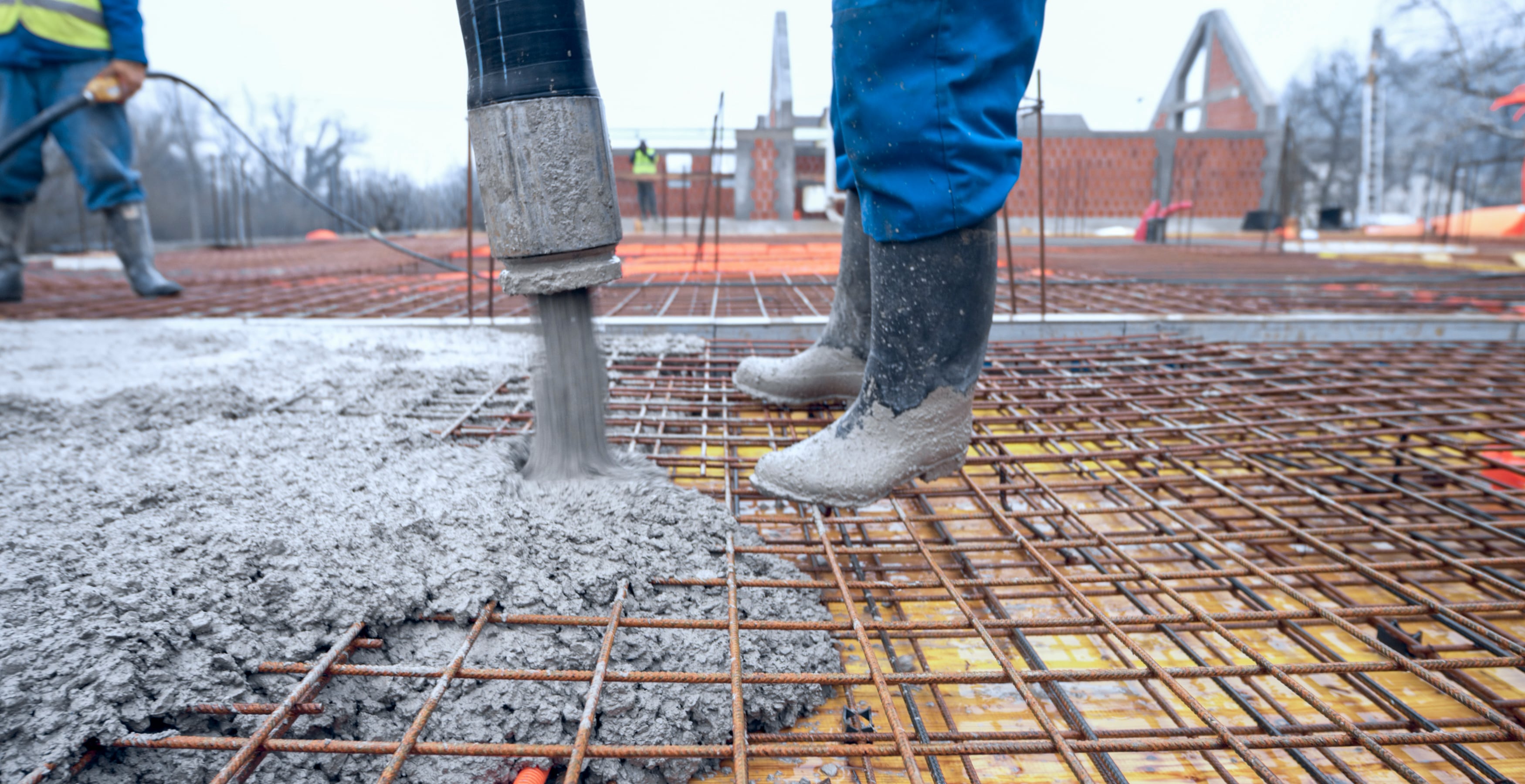
Most custom-home foundation conversations in Orange County come down to two systems: slab on grade and post-tension. Architects often default to post-tension because it's the higher-spec option, but on the right lot, conventional slab on grade is the smarter call — better economics, similar performance, and a lifespan that easily clears the design life of the home.
Here's how the two systems actually compare in our experience.
What each system actually is
Slab on grade is a single layer of concrete poured directly on a prepared subgrade, reinforced with steel rebar in a grid pattern. The slab carries the loads of the structure above it down to the soils. It's the default residential foundation system across most of the US.
Post-tension uses the same concrete-on-grade approach, but instead of conventional rebar, the slab is reinforced with high-strength steel tendons that get stressed after the concrete cures — typically seven to ten days post-pour. Stressing puts the entire slab under compression, which lets it resist tension cracks from soil movement that would otherwise show up in conventional slabs.
When post-tension wins
### Expansive clay soils This is the biggest one. If the geotech report shows expansive clays with a plasticity index above 20 — common in parts of Coto de Caza, Ladera Ranch, and inland canyons — soil movement under seasonal moisture changes will crack a conventional slab. Post-tension prevents that by keeping the concrete in compression.
### Large open-plan slabs Modern architectural designs love uninterrupted floor plates — no interior bearing walls, no slab joints in the great room. Post-tension lets the slab span longer distances without joints because the tendons keep it from cracking.
### Crack-sensitive finish floors Polished concrete, large-format porcelain, marble, and continuous-pour epoxy floors all hate cracks. Even a hairline crack in a conventional slab will telegraph through. Post-tension is the standard call when the architect specifies a finish like this.
### Hillside lots with differential settlement risk If the geotech indicates uneven settlement across the footprint, post-tension distributes the load more evenly than a conventional slab — the tendons act as a stiffening grid that resists localized movement.
When slab on grade is the right call
### Sandy or well-graded soils Coastal lots with sandy soils typically have low expansion potential (PI under 15). Conventional slab on grade handles these conditions perfectly well. Post-tension's premium doesn't buy you anything you need.
### Smaller footprints On a footprint under 2,500 sf with multiple interior bearing walls, the slab is naturally segmented by the foundation system. Post-tension's continuous-slab benefit doesn't have anywhere to express itself. Conventional rebar is cheaper and equally durable.
### Traditional finish floors If the architect spec calls for wood floors with a moisture barrier, carpet, or smaller-format tile, hairline slab cracks won't be visible at the finish layer. Conventional slab is fine.
### Tight budget where the money is better spent elsewhere The $4 – $8 per square foot premium for post-tension on a 3,000 sf footprint is $12,000 – $24,000. On a project where every dollar matters, that money may produce more visible value invested in upgraded finishes or systems than in foundation tech the client will never see.
Cost comparison — typical OC ranges
| System | Cost per sf of footprint | Typical add-on | |---|---|---| | Slab on grade | $22 – $40 | None — the baseline | | Post-tension | $30 – $55 | +$4 – $8/sf over slab on grade |
These are foundation-only numbers — concrete, rebar/tendons, formwork, stressing (PT only), and inspection. Excludes excavation premiums, retaining walls, drainage envelope, and permit fees.
For a 3,500 sf footprint custom home:
- Slab on grade: $77,000 – $140,000 - Post-tension: $105,000 – $190,000
The variance within each range is driven mostly by soils, grade, and edge-beam complexity — not by the system itself.
Performance over thirty years
Both systems, installed correctly, will outlast the home. The difference shows up in how they fail when things go wrong:
- Slab on grade failure mode: Hairline cracks that grow under repeated thermal cycling and soil movement. Usually cosmetic at the finish layer for the first ten years. Becomes structurally relevant if a hairline crack propagates through a load-bearing area, but that's rare in a properly designed slab.
- Post-tension failure mode: Tendon corrosion at the anchor ends, typically from water intrusion if the edge detail isn't properly sealed. Less common but harder to repair when it happens. Modern PT systems with encapsulated tendons have largely solved this — the failure rate on systems installed since 2010 is near zero.
What we typically recommend
Most of our Skyrise foundation projects in inland OC (Coto de Caza, Ladera Ranch, RSM, Mission Viejo) end up as post-tension — the soils make it the right call.
Most of our coastal OC projects (Newport Beach, Laguna Beach, Dana Point) end up as conventional slab on grade — the sandy soils don't need the premium, and the budget goes further on the upgraded coastal envelope (chloride-resistant rebar, higher-psi mix, drainage envelope) instead.
But every site gets evaluated against the geotech report individually. We've recommended PT on coastal lots when the soils came back unusually expansive, and recommended conventional slab on Coto projects when the lot history showed stable subgrade.
How to decide for your project
Three questions:
1. What does the geotech report say about expansion? PI > 20 leans PT. PI < 15 leans conventional. 2. What's the architectural slab intent? Open-plan with crack-sensitive finishes leans PT. Compartmentalized layout with traditional finishes leans conventional. 3. What's the budget tradeoff? The $4 – $8/sf premium for PT is real money — make sure it's buying you something the rest of the project values.
If you're working through this on a specific project, [we'll review your geotech and the architect's structural intent](/contact) and recommend the right system. There's no upcharge for the consult — and we'll tell you when the cheaper option is the right answer.